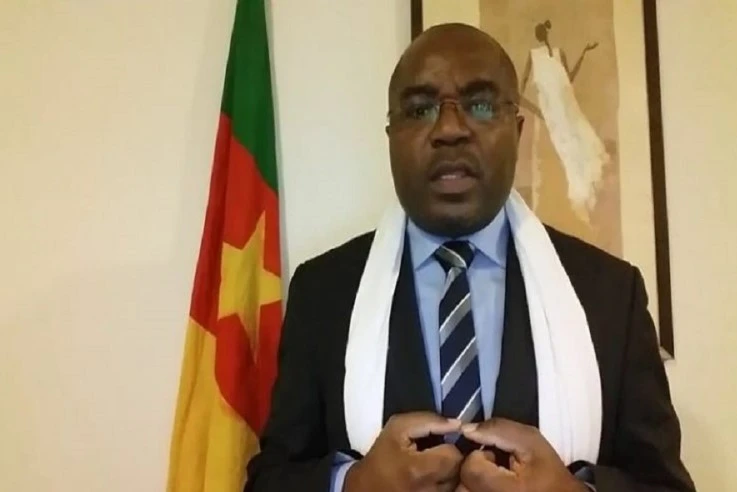
In a bold move to reshape Cameroon’s political future, opposition figure and intellectual Vincent-Sosthène Fouda has unveiled a constitutional reform proposal that could redefine presidential succession in the country. At the heart of this initiative is a four-year presidential term, renewable up to three times, and a two-year transitional cohabitation between the outgoing and incoming presidents.
This model aims to break the long-standing narrative that “after Biya, comes the deluge” — a phrase that has haunted Cameroonian political discourse for decades.
A New Architecture for Power Transition
The reform introduces a structured and anticipatory transition mechanism. During the third and final term of a president, early elections would be held at mid-term. The elected successor would not immediately assume office but would instead undergo a two-year institutional integration, working alongside the outgoing president without exercising executive power.
“The president-elect would be gradually introduced to the realities of governance before taking the oath of office,” explains Fouda.
This cohabitation period is not about shared power, but about structured transmission — a form of political apprenticeship designed to ensure continuity, stability, and institutional memory.
Inspired by Global Best Practices
Fouda’s model draws inspiration from international systems:
In the United States, the president-elect waits several months before taking office, allowing for a smooth transition.
In France, the lack of such preparation has been criticized, notably in the case of François Hollande’s presidency.
But Cameroon’s proposed model goes further by institutionalizing the transition, offering a unique African approach to democratic succession.
Preparing a Governing Elite
After nearly five decades of Paul Biya’s rule, Cameroon faces a critical challenge: how to ensure the continuity of the state without collapse. Fouda’s proposal addresses this by emphasizing the formation of a new governing elite — one that is trained, prepared, and capable of assuming leadership without chaos.
This reform is not just about changing the rules of the game; it’s about changing the culture of power.
From Personal Power to Institutional Stability
The proposal directly challenges the personalization of power that has defined Cameroon’s political landscape. It seeks to:
Depersonalize leadership by focusing on institutions, not individuals;
Rebuild public trust in politics through transparency and predictability;
Serve as a model for other African nations grappling with succession crises.
A Democratic Laboratory for Francophone Africa?
Observers see this as a potentially transformative model for the region. By offering a clear, peaceful, and structured path to power, it could inspire reforms across Africa, where transitions are often marked by uncertainty and unrest.
“This is about reconciling Cameroonians with politics,” says Fouda. “It’s about proving that power can be passed on — not seized.”
By Valentine Ngapout Political Analyst
Ne manquez aucune actualite !
 Suivez-nous sur Google Actualites
Gratuit - Mises a jour en temps reel - Sur mobile et desktop

Journaliste spécialisée dans les questions politiques, Christiane Tamoura Engo suit de près l'actualité des institutions camerounaises, des partis politiques et des grandes décisions qui façonnent le Cameroun et l'Afrique centrale.Rédactrice pour 237online.com, elle s'attache à décrypter les enjeux politiques pour les rendre accessibles à tous les Camerounais, qu'ils soient au pays ou dans la diaspora.
📰 Voir tous ses articles →